Buying a home in Colorado is part lifestyle decision, part legal process, and part timing. The mountains, the 300-ish days of sunshine people love to quote, and the easy pace of South Denver suburbs draw buyers from every corner of the country. But the way a Colorado purchase actually works, from the state-approved contract to metro districts and hail-season roofs, surprises a lot of people, including buyers who have owned several homes elsewhere.
This guide walks you through the whole thing: what the market looks like heading into 2027, how the Colorado home buying process works step by step, the deadlines that matter, the costs most people underestimate, and how to think about the South Denver communities where I spend my days.
The short answer: Buying a home in Colorado follows a state-standardized contract with strict, date-specific deadlines for inspection, title, appraisal and financing, so preparation before you write an offer matters more than speed. Heading into 2027, the Denver metro market has more inventory and more negotiating room than the pandemic years, while mortgage rates remain above 7%. Budget for Colorado-specific items like metro district taxes, HOA fees, radon testing and hail-driven insurance costs, not just the purchase price.
What Does the Colorado Housing Market Look Like Heading Into 2027?
The honest headline: this is a calmer, more balanced market than many buyers expect. You have time to think, inspect and negotiate, which was rare a few years ago. Here is where things stood in the most recent reports.
Metric | Latest figure | Source |
|---|---|---|
Denver metro median close price, all homes (Sept. 2026) | $575,000, down about 2% year over year | REcolorado / DMAR |
Denver metro median price, single-family detached (Sept. 2026) | $635,000, flat year over year | DMAR |
Active listings, end of Sept. 2026 | 13,567 | DMAR |
Median days in MLS (Sept. 2026) | 32 days, down from 35 a year earlier | DMAR |
$1M+ closed sales, year to date | 4,449, up 1.99% | DMAR |
Colorado statewide median sale price (Aug. 2026) | $552,599, up 0.5% year over year | Redfin |
30-year fixed mortgage rate (week of Oct. 8, 2026) | 7.40%, versus 6.30% a year earlier | Freddie Mac |
A few things stand out. Overall closed sales in the Denver metro were down 21.39% year over year in September, according to DMAR, while luxury activity held up: year-to-date sales of $1 million and up rose slightly, and dollar volume in that segment reached $7.30 billion. REcolorado put metro inventory at roughly 20 weeks of supply in September. In plain terms, higher rates have slowed the middle of the market more than the top, and buyers in nearly every price range have more choice than they did in 2021 or 2022.
What does that mean for you? You can usually negotiate inspection items and closing terms again. Well-priced, well-presented homes in desirable South Denver pockets still move quickly, so "balanced" does not mean "no competition."
How Does the Colorado Home Buying Process Work, Step by Step?
Here is the Colorado home buying process from first conversation to keys.
1. Sign a written agreement with your broker
This one is new. As of August 12, 2026, Colorado law (House Bill 26-1426) requires a written agreement between you and your real estate broker before the broker performs licensed services for you. The agreement establishes the type of relationship (single agency or transaction-broker) and must clearly disclose how and how much the broker is paid. Expect to see this early, and read it the same way you would any other contract.
2. Get fully pre-approved, not just pre-qualified
With rates above 7%, a few tenths of a point change your monthly payment meaningfully. A full pre-approval, where the lender has reviewed income, assets and credit, makes your offer stronger and tells you your real ceiling. Luxury buyers should also ask about jumbo loan requirements, reserves and any rate-lock options early.
3. Narrow down communities before you tour homes
South Denver communities feel very different from one another. Lot sizes, commute routes, HOA structures, metro districts and school district boundaries all change from one side of a road to another. Choosing two or three target areas first saves weeks of touring.
4. Write your offer on the Colorado state contract
Colorado uses a standard Contract to Buy and Sell Real Estate approved by the Colorado Real Estate Commission. Instead of vague "contingency periods," it lists specific calendar deadlines for each step. Your offer is really a negotiation over price, terms and those dates.
5. Deliver earnest money
Once your offer is accepted, you deposit earnest money with the holder named in the contract, typically the listing brokerage or the title company. If you terminate properly under one of the contract's deadlines, it is generally returned. Miss a deadline, and that protection can disappear.
6. Inspect everything that matters
Before the Inspection Objection Deadline, you will want a general home inspection and, in Colorado, a radon test. Depending on the property, add a sewer scope, roof evaluation, and specialists for pools, wells, septic systems or mountain-area features. You can terminate before the Inspection Termination Deadline, or submit an objection and negotiate repairs or credits with the seller.
7. Review title, HOA and metro district documents
The title commitment, HOA governing documents, budgets and meeting minutes, and any metro district disclosures arrive during this window. This is where you learn about easements, special assessments, architectural rules and the true tax picture.
8. Appraisal and loan approval
If you are financing, the appraisal must come in before the Appraisal Deadline, and your lender works toward full loan approval before the loan-related deadlines. If the appraisal comes in low, you can renegotiate, cover the gap, or terminate within the contract's terms.
9. Secure homeowners insurance early
The Colorado contract includes a property insurance deadline for good reason. Insurance on the Front Range has become more expensive and, for some homes, harder to place. Get quotes during your inspection period, not the week before closing.
10. Final walk-through and closing
Closings in Colorado are handled by a title company. You will do a final walk-through, sign, fund and receive keys based on the possession terms in your contract.
What Are the Key Deadlines in a Colorado Real Estate Contract?
Every date in the Colorado contract is negotiated in the offer, and the contract treats time as of the essence. Here are the deadlines buyers ask about most.
Deadline | What it means for you |
|---|---|
Earnest money deadline | When your deposit must be delivered to the holder. |
Record and off-record title deadlines | When title documents and related records must be delivered for your review. |
Title objection and resolution deadlines | Your window to object to title issues and the seller's window to fix them. |
Inspection termination deadline | Your last day to walk away based on the property's condition. |
Inspection objection and resolution deadlines | When repair requests are due and when both sides must agree in writing. |
Appraisal deadline | Your last day to act on a low appraisal. |
New loan terms and loan termination deadlines | Your financing protection if the loan terms change or the loan is not approved. |
Property insurance termination deadline | Your protection if acceptable insurance is not available. |
Closing date | When the purchase is completed and funded. |
Two practical rules: deadlines can only be changed in writing with a signed amendment, and a missed deadline usually cannot be undone. A verbal "sure, take another day" is not an extension.
📘 Free Guide: The 2027 South Denver Buyer's Guide
Get the Colorado purchase process and contract deadlines in one place, plus a South Denver market overview, a budgeting framework and a printable buyer checklist you can use from pre-approval to closing.
Want a copy? Simply email me for your free copy.
What Costs Should You Budget For When Buying a Home in Colorado?
The purchase price is only the start. These are the Colorado-specific costs that catch buyers off guard.
Property taxes
Colorado property taxes are calculated by applying an assessment rate to your home's assessed value and then multiplying by the local mill levy, which varies by address. For the 2026 tax year, the state's residential school assessment rate is set at 7.05%, with a separate rate for local governments. Mill levies differ widely between neighborhoods, so always look up the actual tax history of the specific home through the county assessor and treasurer.
Metro districts
Many newer Colorado subdivisions sit inside a metropolitan district, a special district formed under state law to finance roads, water lines, parks and other infrastructure. Homeowners repay that debt through an additional mill levy on their property tax bill. Colorado law requires sellers of homes in many of these districts to give buyers the district's official website, where you can find its authorized debt and maximum mill levy. Two similar homes a mile apart can carry noticeably different tax bills because of this.
HOA dues and community fees
Most South Denver neighborhoods have an HOA, and some have more than one layer, such as a master association plus a sub-association. Ask about dues, what they cover (trash, snow removal, pools, security gates), reserve levels and any planned special assessments.
Homeowners insurance and hail
According to an analysis released by the Colorado Division of Insurance, hail is the number one factor driving up homeowners insurance rates in Colorado. Roof age, roof material and your hail deductible matter as much as the premium, so compare policies line by line.
Radon
The EPA places Colorado in its highest radon zone, where the average home is expected to exceed the indoor action level of 4.0 picocuries per liter. Since 2023, Colorado sellers must disclose known radon test results and mitigation history and provide the state's radon information, but a test is not required, so order your own. Mitigation systems are common and usually a manageable fix.
Closing costs
Colorado's state documentary fee on a deed is modest, one cent per $100 of value, so a transfer tax will not be a major line item at the state level. Your real closing costs come from lender fees, title and escrow charges, prepaid taxes and insurance, and HOA transfer fees. Your lender's Loan Estimate will itemize these.
Where Should You Look When Buying a Home in South Denver?
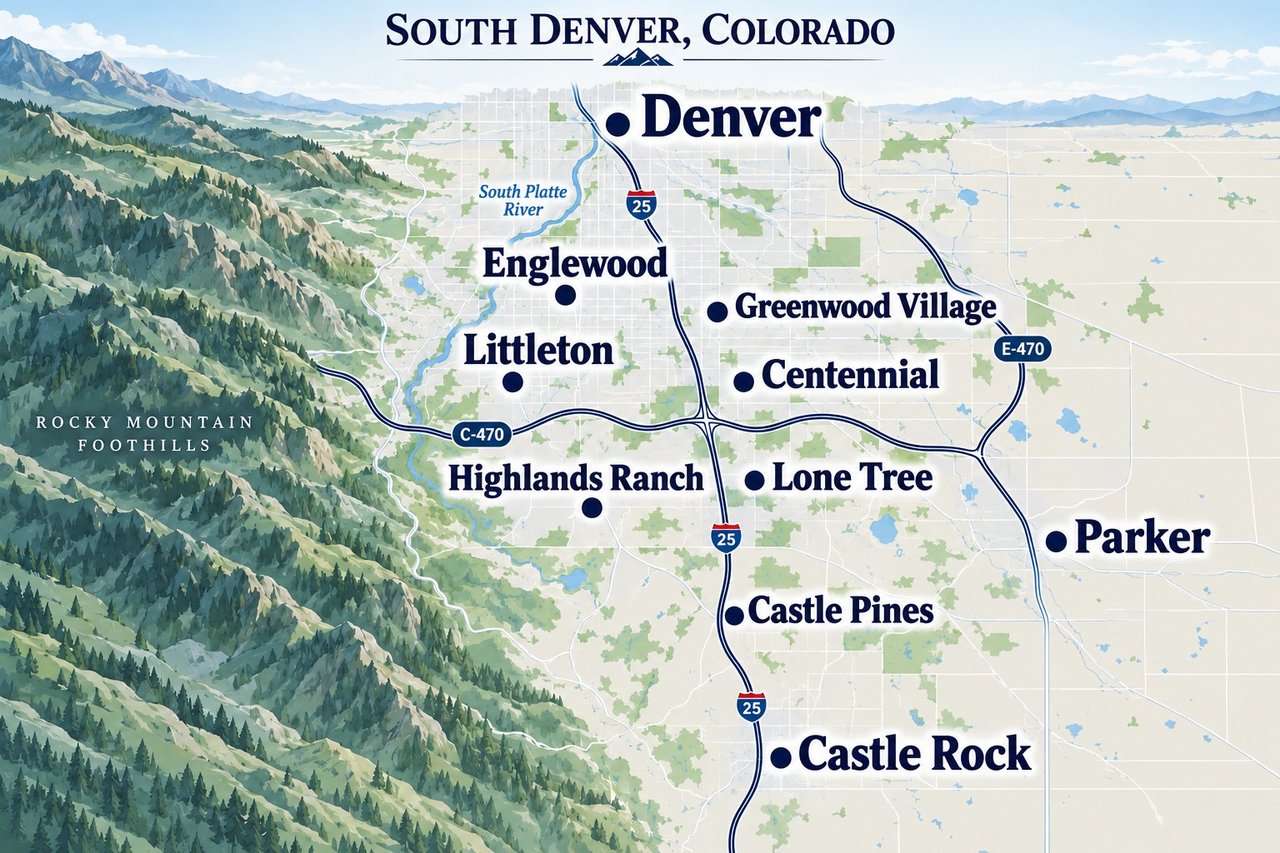
South Denver is not one market. It is a collection of very different communities, each with its own feel, home styles and price points. Here is a side-by-side starting point.
Community | County | Public school district* | Character and setting | Main routes |
|---|---|---|---|---|
Cherry Hills Village | Arapahoe | Primarily Cherry Creek School District | Large lots, estate homes, horse properties, Cherry Hills Country Club | University Blvd., Belleview Ave., I-25 |
Greenwood Village | Arapahoe | Cherry Creek School District | Established luxury neighborhoods beside the Denver Tech Center, extensive trail system | I-25, I-225, Southeast light rail stations |
Lone Tree | Douglas | Douglas County School District | Master-planned RidgeGate, Park Meadows shopping, Sky Ridge Medical Center, Bluffs Regional Park | I-25, C-470, E Line light rail to RidgeGate Parkway |
Highlands Ranch | Douglas | Douglas County School District | Large master-planned community with recreation centers, extensive trails and the Backcountry Wilderness Area | C-470, Santa Fe Dr., Broadway |
Castle Pines | Douglas | Douglas County School District | Golf-oriented community including the gated Village at Castle Pines, rolling terrain and mountain views | I-25 |
Castle Rock | Douglas | Douglas County School District | Historic downtown, the namesake butte at Rock Park, Philip S. Miller Park, newer communities on the edges | I-25, Founders Pkwy. |
Parker | Douglas | Douglas County School District | Walkable Mainstreet, PACE Center, Cherry Creek Trail, mix of established and newer neighborhoods | E-470, Parker Rd. (State Hwy. 83) |
*District boundaries do not always follow city lines. Always confirm school assignment by specific address with the district.
If Parker is on your list, my Living in Parker, Colorado: The Complete Guide and Hidden Gems in Parker go deeper on its neighborhoods, trails and local favorites.
How long is the commute from South Denver?
It depends heavily on where you work and when you drive. I-25 is the spine of South Denver, C-470 connects Highlands Ranch and Lone Tree to the west side, and E-470 serves Parker and points east. RTD's E Line light rail runs from Denver Union Station south through the Denver Tech Center to RidgeGate Parkway in Lone Tree, which gives some neighborhoods a car-free option downtown. Test your actual commute at rush hour before you commit.
How Do You Buy a Home in Colorado From Out of State?
A large share of my clients are relocating, and buying from a distance is very doable with the right setup.
- Start with one scouting trip. Spend two or three days driving the communities on your shortlist on a weekday and a weekend.
- Use live video tours. A real-time walk-through lets you ask about noise, light, views and what is next door, things listing photos never show.
- Line up a Colorado-experienced lender and insurance agent early. Both affect your deadlines.
- Plan your inspection trip around the inspection deadline. If you can be there for the inspection, be there.
- Ask about remote closing options. Many title companies can coordinate remote or mail-away signing, subject to your lender's rules.
- Think about seasons. Colorado winters are generally sunny with snow that melts quickly in the metro, but driveway slope, orientation and snow removal policies are worth noticing.
What Are the Biggest Mistakes Colorado Home Buyers Make?
- Treating deadlines casually. The Colorado contract is date-driven. Calendar every deadline the day you go under contract.
- Skipping the radon test or sewer scope. Both are inexpensive compared with what they can uncover.
- Ignoring the metro district. Read the district's website and the property's actual tax bill, not just the listing estimate.
- Getting insurance quotes too late. Roof age and hail history can change premiums significantly.
- Assuming school boundaries follow town names. They often do not. Confirm by address.
- Waiting for "perfect" market timing. Rates and prices both move. The better question is whether the home, the payment and the timing work for your life.
Buying a Home in Colorado: Frequently Asked Questions
Is 2027 a good time to buy a home in Colorado?
The Denver metro has more inventory and more negotiating room than during the pandemic years, with roughly 20 weeks of supply in September 2026 per REcolorado. Mortgage rates above 7% are the main headwind. The right time depends on your plans, budget and how long you expect to stay.
How much is the earnest money deposit in Colorado?
There is no fixed amount. Earnest money is negotiated in each offer and held by the party named in the contract, usually the listing brokerage or title company. It is generally refundable if you terminate properly before a contract deadline.
Do I need a radon test when buying a home in Colorado?
It is not required by law, but it is strongly recommended. Colorado is in the EPA's highest radon zone. Sellers must disclose known radon test results and mitigation, but only a new test tells you the home's current level.
What is a metro district in Colorado?
A metro district is a special taxing district, often created in newer subdivisions, that finances infrastructure like roads, water lines and parks. Homeowners repay that debt through an added mill levy on their property taxes, so it directly affects your annual cost of ownership.
Are property taxes high in Colorado?
It varies more by address than by state. Your bill depends on the local mill levy, which includes any metro district. Always check the specific property's tax history with the county treasurer.
Do I have to sign an agreement with my real estate agent in Colorado?
Yes. Since August 12, 2026, Colorado requires a written agreement between a buyer and broker before the broker provides licensed services. It must define the relationship and clearly disclose the broker's compensation.
How long does it take to buy a home in Colorado?
Once you are under contract, the timeline is set by the dates you negotiate in the offer, with financed purchases typically needing more time than cash purchases for appraisal and loan approval. The search phase before that can take a weekend or several months.
The Bottom Line on Buying a Home in Colorado
Buying a home in Colorado rewards preparation. Know your numbers, understand the contract's deadlines, look past the list price to taxes, metro districts, HOA dues and insurance, and choose your community before you fall for a kitchen. Do that, and the process feels far less overwhelming, especially in a market that finally gives buyers a little room to breathe.
For a deeper look at what today's buyers are prioritizing, read What Buyers Want in 2026.
📘 Want everything in this guide in one printable resource? Grab The 2027 South Denver Buyer's Guide. Simply email me for your free copy.
Ready to Talk Through Your Move?
Whether you are relocating from another state or moving across town, I am happy to help you map out the right communities, the right timing and a strategy that fits your goals. No pressure, just clear local insight.
📅 Schedule your Real Estate Strategy Call: https://calendly.com/thelanacollection/coaching-session